
'China did not expect India to show such strategic resolve in defending its territorial integrity.'

Major General Sujan Singh Uban, a legendary veteran of the Second World War, was a natural choice to raise, train and command the Special Frontier Force and mould them into a well oiled fighting machine, recalls his son Inspector General Gurdip Singh Uban (retd), who led SFF troops during the Kargil War.

'Chinese troops are not geared to fight Indian troops who are battle hardened and acclimatised and are far more hardy.'

'It is a game of patience. We have to stand firm and tire them out, which we are doing.'

'The PLA has continued to do exercises and drills and recently carried out air exercises with fighter jets.'
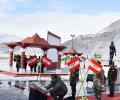
The Chinese authorities have been rapidly building defence infrastructure along the Line of Actual Control, indicating that they are preparing for a long period of tension with India, points out Jayadeva Ranade, the former senior RA&W officer and China expert.

It took India and the Indian Army to show to the world that enough is enough and to challenge the neighbourhood bully, he said.

'In the short term the relationship will get worse.'

Chinese President Xi Jinping has bestowed special honours on a PLA battalion posted in Tibet close to Arunachal Pradesh for its "outstanding performance in safeguarding borders".

The Chinese have just one commander for all the forces confronting India. Commanders of all these forces answer to one man, and one headquarter. India, on the other hand, offers a diversity of options that is a military embarrassment in the 21st century. In Arunachal and Sikkim-Bhutan, the Eastern Army Commander is in charge. In the Uttarakhand (central) sector, it will be the Central Army Commander. The Himachal-Tibet border is the domain of the Western Army Commander. And all of Kashmir and Ladakh further on, the Northern Army's. Effectively, an array of at least eight 'three-star' commanders will be arrayed against one Chinese, says Shekhar Gupta.

The high-level talks came a week after 20 Indian Army personnel were killed in a violent clash between the two sides in Galwan Valley.
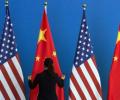
Throughout its standoff with India along the Line of Actual Control (LAC), Chinese officials sought to downplay the severity of the crisis, emphasising Beijing's intent to preserve border stability and prevent the standoff from harming other areas of its bilateral relationship with India, the Pentagon said in a report on Tuesday.

'Galwan has turned everything.' 'The casualties on both sides alerted the Chinese to the fact that Indians are not going to take it lying down.'

Overall, the People's Liberation Army Air Force (PLAAF) has focused on building ground-based air defense networks and network-centric operations rather than trying to match the Indian Air Force (IAF) in terms of straight fighter numbers along the border. All air assets fall under the Western Theater Command of the PLA, the largest geographic region of China's five military theater commands.

'The PLA is under constant watch.' 'There is an escalation matrix. For every degree of escalation, responses are thought of and trained for.'
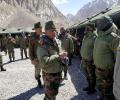
The military preparations underway show that the PLA may undertake operations this summer to achieve whatever objectives they could not achieve last May, asserts Jayadeva Ranade, the distinguished China expert and retired RA&W officer.
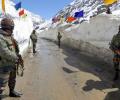
The clear assertion by New Delhi came ahead of a fresh round of Lt General-level talks between the Indian army and the Chinese PLA which government sources said is set to take place within the next two days.

'We have to be prepared on the borders to withstand Chinese expansionist designs.'

China has been taking "incremental and tactical actions" to press its claims at the Line of Actual Control (LAC) with India and has unsuccessfully sought to prevent New Delhi from deepening its relationship with the US during and subsequent to the standoff, the Pentagon has said in a major report on China's military modernisation.

'This was Indian land the PLA advanced on and occupied.' 'The Chinese then 'negotiated' a pullback of their troops a small distance on Indian territory even as Indian jawans draw back further into India from the forward position.' 'An apparently satisfied Indian government says this is a great move for peace! How great is that for China!'
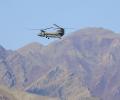
For both India and China, the most likely option -- and the most challenging -- appears to be a freezing of the status quo.

16 Indian Army divisions face China, 20 face Pakistan and two divisions are reserves. This powerful signal can hardly be missed in China or Pakistan, notes Ajai Shukla.

The Indian Army has shown it can face down the PLA, but is too often held back by a political leadership that lacks boldness, asserts Ajai Shukla.
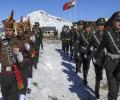
The focus of the deliberations was on finalising modalities for disengagement of troops in eastern Ladakh.

'India's military posture has become significantly stronger than China's on the 3,500-kilometre Line of Actual Control.' 'This is enhancing confrontation between the two sides,' points out Ajai Shukla.

'India and China are already in a warlike situation.'

'Unless India ups the ante, Beijing will continue to believe its transgressions are cost free and will feel encouraged to do more of the same.'

Four Chinese soldiers were killed in the fierce clash with the Indian Army in the Galwan Valley in eastern Ladakh in June last year, the People's Liberation Army (PLA) acknowledged for the first time on Friday.

The video was reportedly shot at Fuyang Railway Station while the troops were preparing to head to a military camp in Hebei province, according to Taiwan News.

A village built by China along the Line of Actual Control in the Arunachal Pradesh sector and mentioned in a recent Pentagon report, is in territory controlled by that country, sources in the security establishment in New Delhi said on Tuesday.
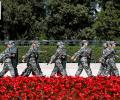
China on Friday hiked its defence budget to $209 billion, maintaining a single-digit growth for the sixth consecutive year with a 6.8 per cent increase in 2021.

'The numbers of troops on both sides are enormous.' 'They are about 50,000-60,000 soldiers facing each other in that sector -- that's about the total number of troops that both sides had in the 1962 War in all sectors.'
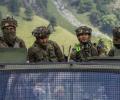
Today, the Ladakhis and Tibetans have been joined by the Sikhs, the Madrassis, the Garhwalis, the Rajputs, who are well trained psychologically and otherwise, to defend the nation, observes Claude Arpi.

Indian Army officers are convinced China is maintaining the pretence of dialogue and negotiations in order to create the opportunity to occupy more Indian territory. Senior Indian planners apprehend this might be a Chinese ploy to divert attention from Depsang, in Northern Ladakh, which might be China's actual target.
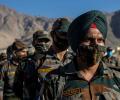
Did Xi deliver a message to Modi at Mamallapuram, which though couched in a velvet glove was time-bound? What was that message? It is clear Indian/Israeli/US spy satellites would not have missed detecting Chinese troop movements towards the Ladakh-Tibet frontier. Then why did some important functionaries in the Government of India choose to only ask the Russians about this in April 2020? Was Russian reassurance of Chinese troop movements being part of a routine exercise the reason that the Leh-based XIV Corps did not mobilise itself for its annual summer exercises near the LAC? A fascinating excerpt from Iqbal Chand Malhotra's new book Red Fear: The China Threat.
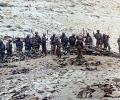
At least 38 PLA troops drowned while crossing a fast-flowing, sub-zero river in darkness, according to an article in the Australian newspaper The Klaxon which cited a report prepared by a group of social media researchers after a year-long investigation.
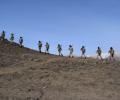
Indian military sources said no firearms were used in the clashes and that most of the injuries were sustained following stone-pelting and use of rods by the Chinese side.

The Chinese air force is now a 400,000-person force that flies some 2,000 combat aircraft -- more than thrice the size of the Indian Air Force.
In all likelihood, the next conventional Chinese attack on India would be preceded by a massive cyber attack designed to cripple Indian networks and interfere with our disaster-relief programmes.

'India has to prepare for future warfare where kinetic use of force at the border will be limited. War will take place in the realms beyond the border.'
 © 2026 Rediff.com - Advertise with us - Disclaimer - Privacy Policy - Sitemap - Feedback - About us - Terms of use - Grievances